

NYC dodges a downgrade. Here’s what that means for your muni portfolio.
The Signal
Municipal bond technicals remain resilient even as yields have moved higher over the past week. The move is being driven less by anything specific to munis and more by a stronger economic backdrop and a Federal Reserve that is telling the market less than it used to.
July manufacturing data came in above expectations, and Fed Chair Kevin Warsh continues to pull back on forward guidance, leaving the market with less visibility into the Fed’s own thinking than investors have grown used to. Together, these two forces pushed yields up roughly 15 basis points across the curve in July. With some tax-equivalent yields approaching 7%, demand has not backed off. Municipal issuance is running at a record pace this year, and the market continues to absorb it without difficulty.
Credit quality is holding up as well. New York City avoided a ratings downgrade this past week from two major agencies, even as those same agencies flagged that the city’s projected budget gaps need to narrow. We view this as a useful data point on where credit risk actually sits right now — it is not the broad municipal market that is under pressure, it is specific, well-understood credits with well-documented fiscal challenges.
We flagged in our July 30 edition that the market would take its cues from Fed policy signals as much as fundamentals. This week is that dynamic playing out in real time — strong data and a quieter Fed are moving yields, not a change in municipal credit quality.
What’s Driving It
New York City’s credit position holds — for now.
Fitch Ratings and Moody’s Ratings both kept New York City’s roughly $53 billion of general obligation debt out of a downgrade this past week, ahead of a $1.5 billion bond offering. Both agencies maintained a negative outlook and were explicit that the city needs to show real progress narrowing its projected budget deficits, or a cut becomes more likely at the next review. For bondholders, this is a hold-and-watch situation rather than a resolved one. We continue to monitor the city’s fiscal plan closely for clients who hold this paper.
A stronger economy is pushing yields up.
The ISM Manufacturing PMI rose to 55.6 in July, the highest reading since May 2022 and the seventh straight month of expansion. Production and new orders both accelerated, and the employment index moved back into expansion territory for the first time in a year and a half. Strong growth data of this kind reduces the case for near-term rate cuts, and the market repriced accordingly, contributing to the roughly 15 basis point back-up in yields this month.
The Fed is giving the market less to work with.
Chair Warsh withheld his own rate projection from the Fed’s Summary of Economic Projections at his first meeting as chair in June, and he has been candid that he sees less value in the dot plot and other forward guidance tools than his predecessors did. Less guidance from the Fed means more uncertainty priced into rates in the near term, since the market has fewer signals to anchor expectations around the path of policy. We expect this to remain a live source of volatility at each FOMC meeting for as long as Warsh continues this approach.
Supply is about to pause — right as reinvestment cash peaks.
July’s new-issue supply pulled back meaningfully from June’s record pace, and issuance should stay manageable through August as investor activity tapers following fiscal year-end. Historically, August issuance runs about 9% below June’s peak. That relief will likely be short-lived: historical patterns point to issuance rebounding roughly 33% by October as autumn supply picks back up.
The timing matters. August also marks the year’s largest wave of tax-exempt coupon and principal payments returning to investors — roughly $56 billion, more than double April’s seasonal low. That reinvestment cash will be looking for a home just as the market catches its breath before fall supply resumes, which is a favorable, if temporary, technical setup.
The window is narrow, though. By September, that reinvestment pool shrinks to a much leaner $30 billion — nearly half August’s total — just as autumn supply starts to build. Investors looking to put this cash to work have roughly a month before the balance of power shifts back toward issuers.
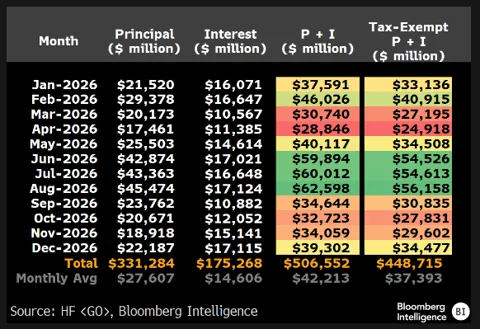
2026 municipal debt service (P+I) by month. Source: Bloomberg Intelligence.
Our Take
The story right now is less about municipal credit and more about the macro and policy backdrop that munis are trading against. Stronger growth data and a Fed that is communicating less are both pushing yields higher in the near term, and that pattern may continue as long as Chair Warsh keeps pulling back on forward guidance.
We are watching three variables closely on your behalf: the pace and substance of Fed communication under new leadership, the timing and size of the anticipated autumn supply pickup, and how well-known credits with active fiscal challenges, like New York City, manage the scrutiny they are currently under. None of these represent a change in the underlying strength of the asset class, but each could add near-term volatility.
The August reinvestment wave is the more constructive story. A substantial amount of tax-exempt cash is returning to investors at the same moment the market is digesting a seasonal pause in new supply. That combination has historically supported municipal prices, and we would expect a similar dynamic this year, even with the fall issuance calendar building behind it.
We continue to view current yield levels as attractive for clients looking to put capital to work, particularly ahead of the technical tailwind August’s reinvestment wave may provide.
Recommendations
Put the August reinvestment window to work.
Roughly $56 billion in tax-exempt principal and interest is returning to investors this month, the largest wave of the year. That pool shrinks to roughly $30 billion by September, so the window to deploy it before fall supply resumes is narrower than it looks.
Treat Fed communication as a new source of volatility.
With Chair Warsh scaling back forward guidance, expect less clarity from each FOMC meeting than the market has grown used to. Build that uncertainty into your rate expectations rather than treating any single meeting as a clean read on the path ahead.
Prepare for the autumn supply pickup.
Issuance has historically rebounded sharply in October after the late-summer pause. Investors with dry powder may want to have it ready to deploy as the technical picture shifts from favorable to more supply-heavy.
Stay engaged as high-profile credit stories develop.
New York City’s ratings outcome this week is a reminder that credit fundamentals remain in focus even amid strong broader economic data. Reach out if you’d like to discuss how these dynamics affect your specific portfolio.
Let’s Talk
If you would like to discuss any of the above in the context of your portfolio, reach out. This market environment rewards preparation — and that is exactly what we are here to help with.