

Taxable-equivalent muni yields just topped 7%. Here’s what that means for your portfolio.
The Signal
Munis’ federal tax exemption is doing double duty this month, keeping borrowing costs manageable for issuers while handing investors some of the highest tax-adjusted yields in years. Investment-grade paper now offers taxable-equivalent yields above 7% in parts of the curve, and record supply paired with a seasonal drop in redemptions could give buyers more leverage this fall.
Bottom line for the month: yields are up roughly 7 basis points across the curve, which will likely leave fixed income slightly negative for August, though not as steep as July’s decline. We started seeing “5s at par” structures reemerge last week and have been active buyers. We do not currently expect a rate move in September, and yields look to us like they are sitting in a genuine sweet spot for anyone adding to a fixed income allocation.
We have been making the case for tax-equivalent yield to clients for months. This month’s data is simply the market confirming it.
What’s Driving It
Supply and Demand Technicals
Year-to-date issuance remains on a record pace at just over $428 billion. This week’s $10.4 billion calendar is healthy for late August but shows the usual summer-end slowdown. Demand stays supportive: muni funds took in another $838 million this week, including $304 million into longer paper. September redemptions drop 45% month over month, while October supply is projected to rise 31% over September, a seasonally large jump. We believe that mismatch could keep creating attractive entry points through the fall.
Credit Spotlight: MTA and New York Transit
We have been bullish on this credit for some time and buyers since Covid. The MTA’s real estate transfer tax bonds were upgraded a notch to AA- by S&P, citing resilient demand in New York City’s luxury real estate market. The Triborough Bridge and Tunnel Authority plans to offer roughly $850 million of this debt the week of September 7. These bonds have offered New York residents a modest yield premium over comparable credits since Covid, a gap we have flagged for a while. The revenue base carries some ridership-linked risk, but this is infrastructure New York can historically ill afford to let fail. New York residents should call us to discuss.
Macro Crosscurrents: Labor and Housing
Initial jobless claims fell 6,000 to 206,000 for the week ended August 15, below the 210,000 consensus and consistent with a labor market running near historically low layoff levels. As of this writing, the market is pricing roughly a 40% probability of a rate hike at the September Fed meeting; we do not expect a move either way. On the household side, affordability worsened for the first time in nearly three years: payments on a median-priced $410,700 home consumed 34% of a typical family’s income in the second quarter, up from 32%, reversing part of the improvement recorded since early 2025.
Sector-by-Sector Spread Outlook
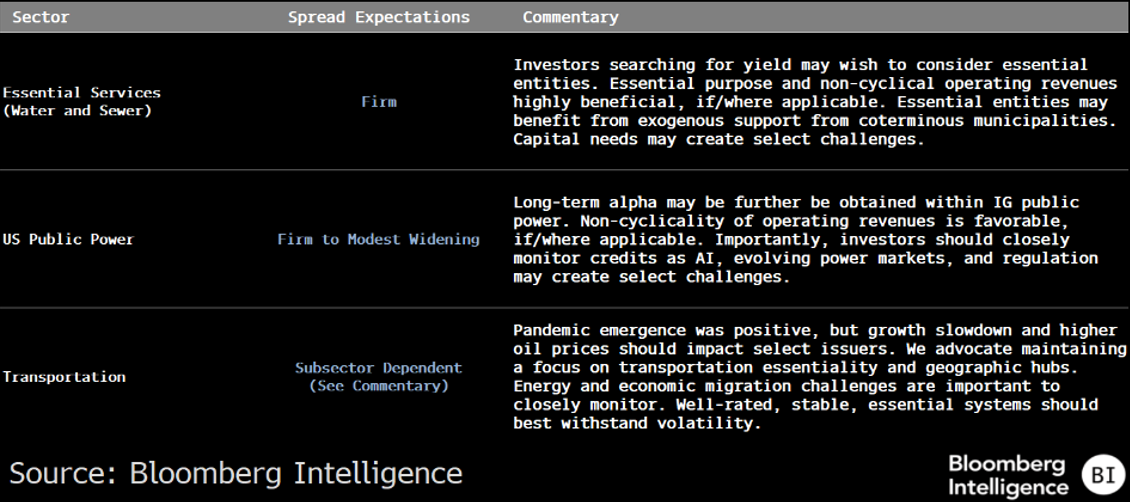
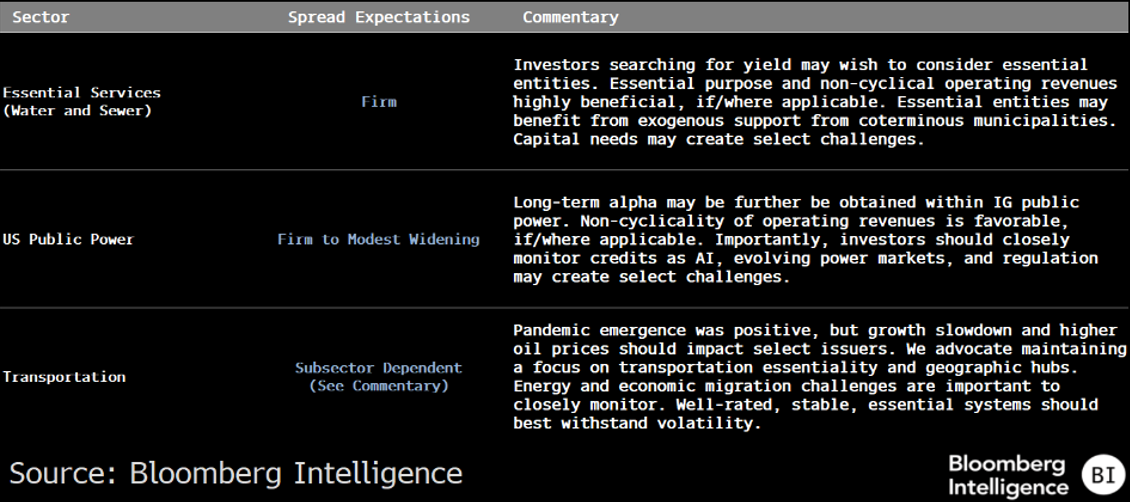
Bloomberg Intelligence’s latest sector work outlines where investment-grade muni spreads could head by category, included below for reference.
Revenue-Backed Sectors
Tax-Backed and General Obligation Sectors
Our Take
Taken together, we think the setup favors patience paired with readiness. Summer dip-buying rewarded investors who stepped into weakness, and similar discipline could pay off again as October’s supply follows a steep drop in September redemptions. Taxable-equivalent yields above 7%, and structures like “5s at par” on insured, A-rated credits, are hard to pass up right now.
Reasonable people can read the macro backdrop differently. Ray Dalio argued this month that investors should trim bonds and hold 10% to 15% of a portfolio in gold, with a smaller bitcoin allocation, to hedge against a US debt crisis he believes could arrive within three years. We take views like this seriously and are glad to discuss how they apply to your portfolio. Three variables we are watching most closely: fall issuance pace, softening housing affordability, and whether labor data shifts the Fed’s calculus. Market direction is never certain.
We will continue to watch supply, demand technicals, and the data the Fed is watching most closely, and we will keep you posted as the picture develops through the fall.
Recommendations
Add exposure ahead of the autumn supply wave
With taxable-equivalent yields above 7% on parts of the curve, and October supply expected to rise against an already-reduced September redemption backdrop, we see this as a constructive window to extend allocations rather than wait for a pullback. Buying above 4.75% out long on higher-grade paper looks particularly attractive right now.
Consider “5s at par” structures on insured, A-rated paper
This structure has reemerged as a way to pick up incremental yield further out the curve, and we have been active buyers on behalf of clients in recent weeks.
New York and New York City residents: look at the upcoming MTA/TBTA offering
The Triborough Bridge and Tunnel Authority expects to bring roughly $850 million of these bonds to market the week of September 7, after a ratings upgrade to AA-. It is a name we have favored since Covid for its yield premium relative to comparable New York credits.
Stay diversified rather than overreacting to any single debt-crisis narrative
Alternative hedges like gold and bitcoin can play a role for some investors, but a well-constructed municipal allocation remains a core piece of a tax-sensitive portfolio. Reach out if you’d like to discuss this in the context of your own portfolio.
Let’s Talk
If you would like to discuss any of the above in the context of your portfolio, reach out. This market environment rewards preparation — and that is exactly what we are here to help with.