

- American public schools went on a borrowing binge in 2025, marking the sector’s biggest year for municipal debt sales in over a decade as dipping enrollment and elevated inflation strain districts’ budgets. School systems around the US issued about $82 billion in muni bonds last year, a nearly 42% jump from 2024 and the most since at least 2013, data compiled by Bloomberg show. That pace of growth outstripped the broader tax-exempt debt market, which saw issuance climb about 15% to a historic high of nearly $568 billion.
- Federal Reserve Governor Stephen Miran said the US central bank will need to cut interest rates by more than a percentage point in 2026, arguing that monetary policy is restraining the economy. “I think it’s very difficult to argue that policy is neutral. I think policy is clearly restrictive and holding the economy back,” Miran said Tuesday during an appearance on the Fox Business Network. “I think that well over 100 basis points of cuts are going to be justified this year.”
- MUNIs are entering the year with valuations that appear rich relative to historical averages, and technicals remain supportive. Forward supply is manageable, fund flows have shown strength, and demand from SMAs remains a steady source of support. Overall, supply will be weak for January, and we expect yields to hold around these levels.
- January MUNI reinvestment this year is more muted, with an estimated $31.3 billion in principal and interest redemptions returning to investors, down from $42.8 billion in January 2025. Of the $21.5 billion principal coming due, roughly $19 billion is tax-exempt, and $2.5 billion is taxable. Illinois leads January redemptions at $2.6 billion, followed by Texas ($2.4 billion) and California ($2.1 billion). Reinvestment demand should strengthen in February, with monthly principal and interest maturities estimated at roughly $38 billion before easing to approximately $25 billion in March.
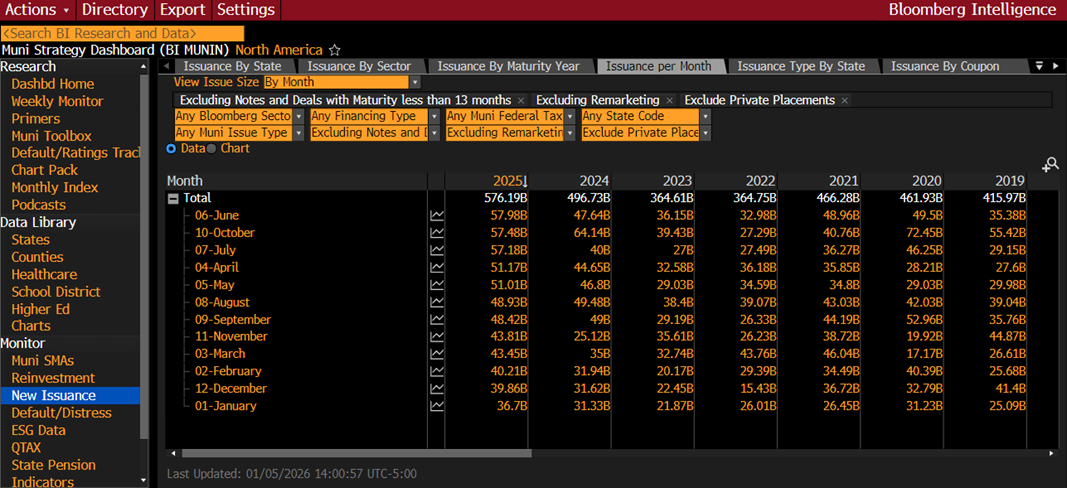
- 2025 marked a record supply year for municipal issuance. Nearly $607 billion in bonds were issued, including $568 billion in tax-exempt bonds, representing about a 15% increase from 2024. January is typically the lightest month for new supply, with February close behind, reinforcing supportive technicals (as stated above) as reinvestment cash returns to the market. Despite the likely slow start to the year, issuance is expected to remain elevated in 2026 as issuers contend with reduced federal support, waning stimulus aid, and inflation-driven cost pressures. I have attached a chart comparing issuance for 2025 compared to previous years.
- The pace of upgrades relative to downgrades, which first showed signs of slowing in mid-2024, decelerated through 2025 but remained net positive. In nominal terms, the three major rating agencies upgraded more than $364 billion of par amount in 2025, down from $384 billion in 2024 and $658 billion in 2023. Downgrades rose to $187 billion in 2025, up from $111 billion in 2024 and $97 billion in 2023, reducing the upgrade-to-downgrade ratio by roughly 2x from 3.5x in 2024. School districts led the downgrades by sector, totaling nearly $38 billion, up from $24 billion last year. Despite school district downgrades (Call for further details on this), we continue to like this credit based on the tax-backed nature of this credit.
- Long-end MUNI yields began the year moving higher as firmer inflation readings and resilient economic activity outpaced expectations. Though the market saw periods of tariff-related, risk-off strength in the spring, elevated volatility and record new-issue supply ultimately pushed several maturities to breach 12-year yield highs.
- Federal Reserve Bank of Minneapolis President Neel Kashkari said interest rates may be close to a neutral level for the US economy now, leaving it up to incoming data to guide the Central Bank’s actions. “Over the last couple of years, we kept thinking the economy was going to slow down, and the economy has proven to be far more resilient than I had expected,” Kashkari, who rejoins the Fed’s voting ranks this year, said Monday on CNBC. As to the above, Federal Reserve Bank of Philadelphia President Anna Paulson said modest additional interest-rate cuts could be appropriate later in 2026. Still, it is conditioned on a benign outlook for the economy.
Bottom Line
We should expect yields to hold steady for the next couple of weeks. As of now, there is only a ~20% chance of a cut later this month; we are on the “fence” based on a possible cut at this time.
Muni Strategy Dashboard 1-9-2026
Securities offered through NewEdge Securities, LLC, member FINRA and SIPC. The DRL Group is not a subsidiary or control affiliate of NewEdge Securities, LLC. NewEdge Securities, LLC. has no affiliation to BondDesk Trading LLC or BondTrader Pro, or Tradeweb Direct, Bondpoint, TMC, Market Axess or any ECN.
Yield to call (YTC) is not indicative of total return; this yield is valid only if the security is called. Bonds may or may not be called, or be callable on multiple dates or, in other cases, called any date following the first call date, so yield to call is based on the earliest stated call date. Discounted bonds may be subject to capital gains tax. Bonds may be subject to OID (Original Issue Discount). Prices and availability may change at anytime without notice.
Do not buy bonds based on the Yield to Call (YTC). Insured bonds are issued for timely payment of principal and interest only. Insured bonds do not cover potential market loss and are subject to the claims paying ability of the insurance company.
Non-rated (NR), With-Drawn (WR), or below investment grade bonds, lower rated bonds, carry a greater potential risk of default & should be considered by sophisticated investors only.
This document is for informational purposes only and does not replace or serve as a substitute for your official monthly statement generated by NFS. Please refer to your official statement for accurate and comprehensive account details.
Bonds may be subject to capital gains tax. This summary is for informational purposes only and is not an offer or solicitation for the purchase or sale of any security or a recommendation or endorsement of any security or issuer. NewEdge Securities, LLC. and DRL Group make no representation about the accuracy, completeness, or timeliness of this information. Bonds could also be subject to the DeMinimis Rule, please consult with your tax advisor for further clarification.
Call us at 281-398-8600 to invest in these or any of our other offerings today.
